
Radical Acceptance

As regular readers know, I read a lot, averaging two non-fiction books a week, almost all of which are hot off the press.
For decades, I focused on political science because I had to keep my comparative politics text book up to date. Once I put that project to bed after ten editions in 2019, I’ve spent almost all of my reading time exploring insights from social and natural scientists, mental health professionals, and entrepreneurs which my peacebuilding colleagues could and should learn from.
Because I do read so much, it’s rare that a single point in anything I read makes me stop and think in dramatically new ways.
That has happened three times in the last month. Together, those insights are helping me focus everything I do—not just my peacebuilding work.
Designing Your Own Life
I’ve been fascinated by design thinking since I first learned about Ideo and Stanford’s d school give or take twenty years ago.
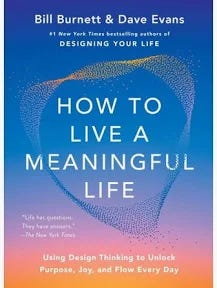
So, I got my copy of Bill Burnett and Dave Evans’ new book, How to Live a Meaningful Life, the day it was published because of the way they had taken the tools that led to invention of game changing new products like the iPhone down to the personal level so that we can do the same in our daily lives.
Both are Silicon Valley icons who have taught a course on designing one’s personal life at the d.school for years.
Their teaching and writing focus on the whole range of issues designers focus on, but I only want to focus on one of them here—something that they call radical acceptance.
They did not come up with the idea, of course. It has deep roots in a number of spiritual traditions, especially those rooted in Buddhism. It is also at the heart of twelve-step and similar recovery programs that rely heavily on the Serenity Prayer, written almost a century ago by Reinhold Niebuhr.
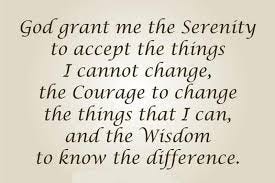
The point Burnett, Evans, and Niebuhr make is controversial.
For the moment, focus on the first three lines and its plea to start with the reality that things are what they are.
There are things I can’t change.
Even though I live in Washington DC and have known plenty of people who hold or held influential positions in the American government, I can’t change foreign policy on my own.
Thinking that I can produce my beloved paradigm shift in one fell swoop amounts to little more than tilting at sociopolitical windmills.
I have to accept that fact.
Or, as they put it, “arguing with reality doesn’t change it.”
As much as we might want it to.
As powerful as our arguments might be.
But as they and dozens of others would argue, that doesn’t mean you have to like that fact.
However, it is the reality that you have to start with.
That takes us to the next two lines and finding the courage to change the things that I can.
Where is the wiggle room in that reality
? Where are the entry points at which I can begin to reshape the system that I don’t like?
And the wisdom too know the difference.
On Oligarchs
That got driven home this week when I read Jeffrey Winters’ new book, The Blind Spot, for my local Oberlin alumni club’s meeting. I had read his earlier works on oligarchs while preparing one of my textbook revisions but hadn’t known that he was an Obie.

When I read The Blind Spot, I realized that his analysis of American oligarchs led me straight to radical acceptance.
His argument is stunning—and depressing. Especially because we met the night before SpaceX’s IPO launched on the stock market—pun very much intended.
But what can I do about them. When taken as a whole, frustratingly little. Sure, I can refuse to buy a Tesla the next time I have to buy a car. Or, I could boycott Amazon. But my son in law just taught me about a new concept of responibilization through which those same oligarchs convince us that we can take those kinds of essentially impact-less actions and delude ourselves into thinking we’ve made a difference when, in fact, the real decisions have to be made by those national institutions which don’t listen to people like me.
But increasingly listen to the oligarchs.
Which is exactly Winters’ point.
That takes me to the middle lines of Niebuhr’s prayer and the rest of design thinking. What if I can think strategically, set a long-term goal, look for those (much smaller) things that I can change, experiment with ideas that could lead to the creation of new institutions like economic coops or neighborhood associations, develop some prototypes, and go from there. Building on our successes and learning from our failures, we could begin designing and creating alternatives to the dysfunctional status quo which extends far beyond the concentration of economic power, as daunting as that might be.
That won’t satisfy people who demand a solution NOW.
In bold and in all caps.
But maybe there is no short term alternative?
Empowering the People I Work With
That led me to something I took from the third book, Genius at Scale, written by Linda Hill, Emily Tedards, and Jason Wild, All of them work in one form or another with the Harvard Business School which, like Stanford, has created more than its share of Winters’ oligarchs.
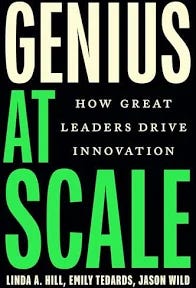
So, it might come as something of a surprise (though it did not for me) that faculty members at those kinds of schools have come up with ways of addressing one obvious problem that emerges when, say, you want to build a movement that changes something that seemingly cannot be changed.
Here, the way Niebuhr’s prayer has been used in my lifetime comes into play.
Despite what many people think, he did not write it for Alcoholics Anonymous and other twelve-step programs. It was, instead, a part of the Christian realism movement of the 1920s and 1930s where it was put to pacifist and anti-fascist uses.
The genius of its adoption by AA lies in its founders’ realization that recovery is a life long journey.
You cannot plan its every step from the outset. It will have twists and turns. Perhaps setbacks and relapses.
It requires the radical acceptance that one is addicted to alcohol, drugs, or even a mindset that leads one to accept he social and political status quo.
It calls for the wisdom to discover the areas in one’s life that one can change and focus on them rather than the impossible targets like the wealth and power that Elon Musk has acquired and will likely hold on to for the rest of his life.
In my case, that means helping the people I reach and empower come to grips with the reality that we are in “it” for the long haul.
That’s where Hill and her coauthors helped. They sought the “secret sauce(s)” that allowed entrepreneurs to take small projects to scale. They not only include the kinds of oligarchs that make Winters’ blood boil but non-profits like a group that has transformed the way children throughout India learn.
As with the design thinking book, let me focus on the theme that both covered most of their examples and that will be most useful as we develop a network of peacebuilders.
They all succeed in “inviting others to take ownership in their future.”
Can you hear the echoes of AA meetings in their words?
They aren’t offering a quick fix let along a miracle cure.
They ask movement leaders like myself to help the people they work with to change the things they can control.
To gradually deepen their equivalent of sobriety.
To gradually become more secure in their own beliefs and, as they do, turn outwards and as the twelfth step ends, “carry this message to alcoholics, and to practice these principles in all our affairs.”
As was the case with Sampark in India, you start with one teacher or one school but your impact ripples out to all the schools in a neighborhood and then to a city and then to six of India’s states.
To be honest, I don’t know how my colleagues and I can do that other than through the kind of ideation, prototyping, and organizational learning that are at the heart of design thinking.
To be honest, too, it will be hard to “sell” a process that is not likely to bring sweeping results before the current election cycle is over or, for that matter, before my lifetime is over.
To be honest one final time, we will have find ways of building what Adam Grant and Wayne Baker call reciprocity rings into our efforts so that the people who work with us see tangible progress in their own lives and in their own projects as clear byproducts of cooperating with us.
In short, our challenge has to include empowering the people who choose to work with us as well as the population as a whole if we want those volunteers to go out and catalyze a society-wide demand for social change—perhaps including building support for policies that tackle the oligarchs and their power.
We Are More Flexible Than We Think
There is one last point that I get books like these whose authors think outside the clichéd box. For whatever reason, they are able to see something that largely eluded me in those days when I spent so much of my time writing comparative politics textbooks.
We are more flexible than most of us think. We don’t have to be constrained by conventional ways of thinking about politics or banking or elementary school education or anything else.
Yes, there may be things that we can’t control today.
And it is no doubt true that trying to envision changing them overnight feels like tilting at windmills and leads to the warranted frustration that oozes from every page of Winters’ book.
But what if we have the wisdom to start by changing the things we can?
Issue an invitation to take ownership of our own futures?
Use the tech tools created by Silicon Valley oligarchs to catalyze initiatives like New Public is?
Or help funders (aka one time oligarchs) make investments in game changing projects the Omidyar network is doing for technology or Media Impact Funders is doing for the news and entertainment communities?
Or as Burnett and Evans put it, can we (re)design our personal and, then, our social lives?
Starting with radical acceptance of the status quo and building toward a better future in which we create new relationships and institutions around the things we are for rather than complain about the people and positions we are against?
Or perhaps most importantly of all, begin building support for new, cooperative ways of solving our country’s problems the only way we can--at least for now--one conversation at a time?
The views and opinions expressed in this article are those of the author and do not necessarily reflect the official policy or position of the Alliance for Peacebuilding or its members.